
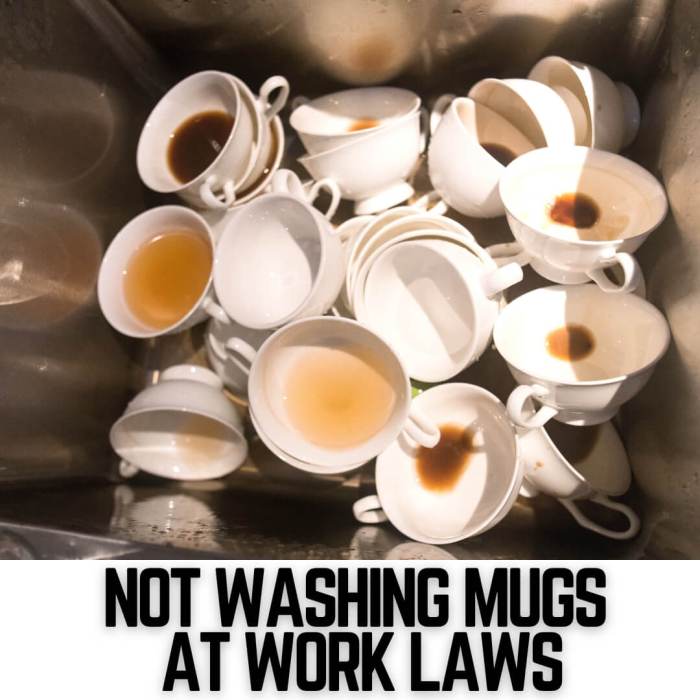
Believe it or not, but some of your no good layabout employees will drink brews at work… but not wash their mugs afterward.
This is every bit as heinous as employees eating at their desks, so take it with the utmost severity of mind.
When one or more employees carry out this sinful act, your workplace sink can become clogged and overflowing with so many mugs it becomes a near fatal health hazard.
It is essential that you as an employer, under your duty of care, ensure all mugs are cleaned in timely fashion to ensure workplace-based mug deaths are kept to an absolute minimum all year round. Here’s how to do just that.
Workplace Mug Laws Aren’t a Mug’s Game
The Drinking Mugs at Work Act 1974 regulates this matter, but is complemented by The Not Washing Drinking Mugs at Work (Instead Just Leaving Them in the Sink) Act 1974.
The two Acts were amalgamated into The Mugs at Work Act 2010, that was until the aforementioned Act caused confusion due to “mug” being undefined and leaving some dullards to comprehend it as a human mug (as in, a person’s face).
As such, the Acts were separated again in 2020 and reinstated with a third Act to be as clear as day. Thus, the Acts now are in order of mug-based importance:
- The Drinking Mugs at Work Act 1974
- The Not Washing Drinking Mugs at Work (Instead Just Leaving Them in the Sink) Act 1974
- The Merger of The Mugs at Work Act 2010 Back Into the Two 1974 Acts so as to Avoid Any Further Confusion (Miscellaneous) Over Informal References to the Human Face Act 2020
Most employers will only need to refer to The Drinking Mugs at Work Act 1974 for reference to their work-based mug needs.
However, if you need to refer to the third Act you’ll need to hire an employment lawyer as this 37,000 page document is one of the most complex legal documents in the history of humankind and has been known to leave even experienced employers weeping pathetically due to its intricacies.
Rest assured, the law is on the side of the employer.
If there is a mass development of mugs in a workplace sink, this is in direct contravention of said Act and, thus, can lead to claims of gross misconduct towards an offending employee. This is detailed in section 561 (f) on page 134,121 in the Act. Hence:
“Employees leaving unwashed mugs in the sink, so as to cause an ongoing blockage of the sink with mugs that have not been cleaned, are immoral scumbags.
As such, it is within the employer’s rights to seek a claim of gross misconduct on behalf of the employee in question. This can result in instant dismissal and/or being hung, drawn, and quartered (if you maintain such a policy in your business).
Most businesses will typically choose instant dismissals for unwashed mug offences. Do note, while this may lead to a high turnover rate of employees (and the high costs associated with constantly replacing employees), it is worth it so as to have a nice clean sink WITHOUT any bloody cups in with a small amount of letf over builder’s brew at the bottom. As that makes our blood boil, too! Goddamn savages…”
As such, you should outline your policy to unwashed mugs at work to ensure your employees follow your procedures. Namely:
- Consume brews, if they must.
- Return the mugs to the kitchen.
- WASH THE MUGS UP!
Stress the last point most vociferously so as to make it very bloody clear indeed you expect ABSOLUTELY NO dirty mugs sitting in the sink. Or else!
The Debate Over Minimal Teaspoons in the Workplace
It’s also essential to address another key factor in the mugs debate. Thusly, it is the lack of teaspoon availability throughout the working day.
There is nothing more infuriating for an employer than watching an employee, aimless and lost, marching for hours on end around a working environment in an attempt to find a spoon to jam into his or her brew.
It’s estimated such an activity costs the UK economy £135 billion every 1,000 years.
The solution to this is to purchase a brand, spanking new set of teaspoons once a week. This will accommodate for weekly thefts and losses, although will cost your business at least £1 billion in lost revenue per annum.
It’s either that or having dozens of employees staggering around aimlessly for half a day whilst teaspoon hunting. We know which one we’d rather have.
To note, there’s an employment law regarding this matter. The Teaspoons at Work Act 1974 dictates the laws regarding how many teaspoons can be maintained in any given working environment at any given time. Namely:
- No fewer than 12.
- No more than 3,000.
It’s believed if there are more than 3,000 teaspoons on a working premises at any given time then Beelzebub Himself will visit your business premises to incinerate it in a hellish inferno.
Whilst some employment law specialists suggest that’s an “old wives’ tale” most employers should ignore, you still can’t be too careful.
As such, always maintain around 1,500 teaspoons at work.
This’ll slake the need for employees to get their brew, all whilst fending off the horrific onslaughts of the devil incarnate.
